
Diwali: The Stories, Traditions and Significance Behind Every Day of the Festival
Five days of lights, legends, family traditions and new beginnings — discover the fascinating stories that make each day of Diwali special.
Diwali, the Festival of Lights, is one of India’s most cherished celebrations. It is a time when homes sparkle with rows of diyas, colourful rangolis adorn doorsteps, the aroma of festive delicacies fills the air, and families come together to celebrate hope, happiness and prosperity.
But Diwali is much more than a festival of lights and celebrations. Every day carries its own significance, rooted in ancient legends, religious beliefs and traditions passed down through generations.
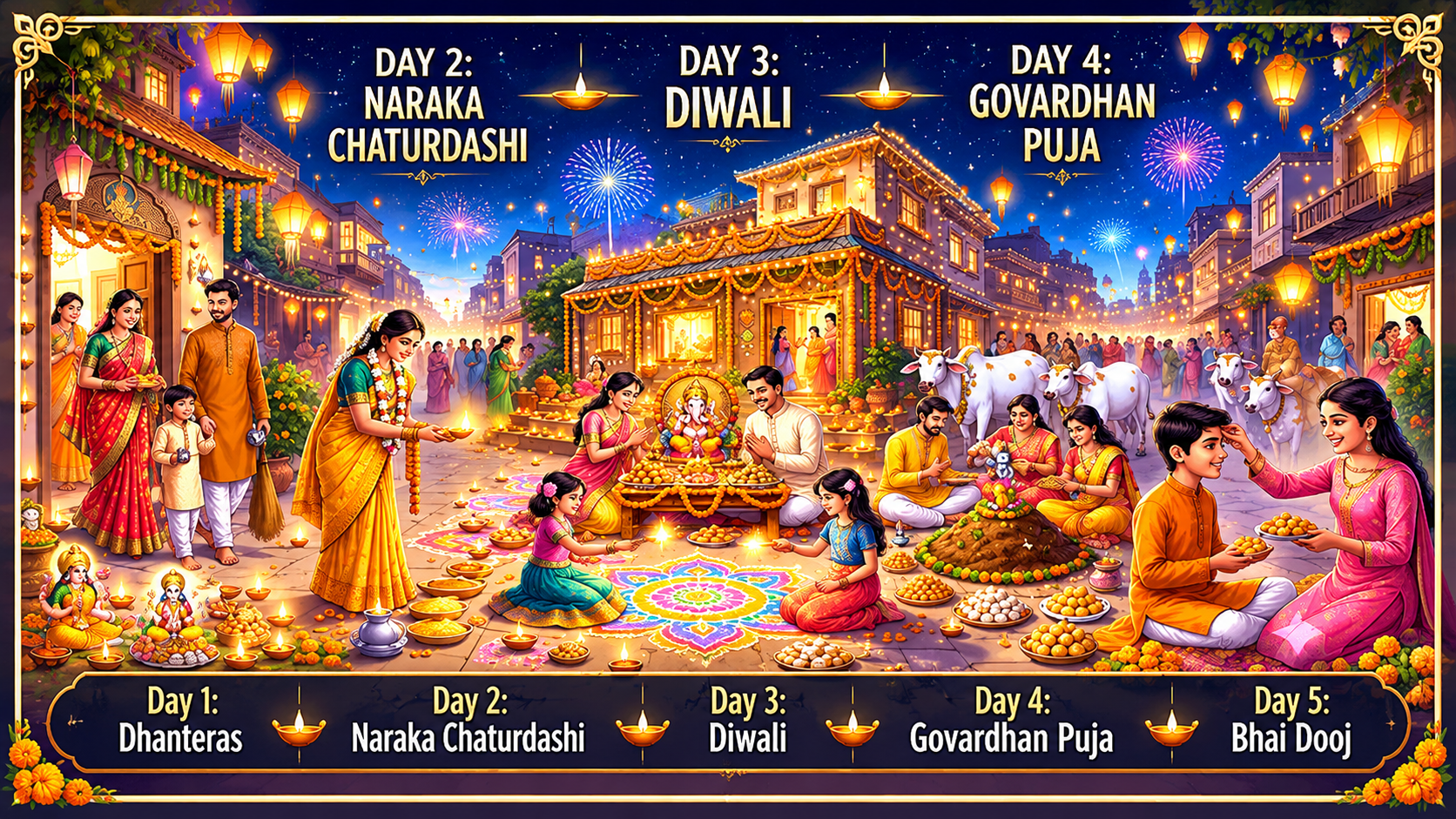
Traditionally, the Diwali festivities begin with Dhantrayodashi, popularly known as Dhanteras, and conclude with Yama Dwitiya, celebrated as Bhai Dooj or Bhau Beej. These five lunar dates are observed over three to five calendar days, depending on the Hindu lunar calendar.
Celebrated in the pleasant autumn season, after the monsoon has receded and the harvest begins to arrive, Diwali marks the joyful culmination of the festive period that starts with Navratri.
Let us explore the stories behind each day and understand why these traditions continue to hold a special place in our lives.
1. Dhanteras: Welcoming Health, Wealth and Prosperity
Dhantrayodashi | The first day of Diwali
Dhanteras marks the beginning of Diwali celebrations. The word combines dhan, meaning wealth, and teras, referring to the thirteenth lunar day.
For many families, this is an auspicious occasion to purchase gold, silver, utensils or other household items. Homes and shops are cleaned and decorated, festive shopping begins in earnest, and the first lamps of the season are lit.
However, the significance of Dhanteras extends beyond material wealth. Two popular legends explain its association with prosperity, health and protection from untimely death.
The story of Lord Dhanvantari
According to Hindu mythology, the gods and demons once joined forces to churn the cosmic ocean in an event known as Samudra Manthan. Among the divine treasures that emerged was Lord Dhanvantari, carrying a pot of amrita, the nectar of immortality.
Revered as the divine physician and associated with Ayurveda, Dhanvantari represents health, healing and longevity. His appearance from the ocean is commemorated on Dhanteras, when many people worship him and pray for the well-being of their families.
The tradition reminds us that good health is among life’s greatest blessings.
The legend of King Hima’s son
Another popular legend tells the story of a young prince, the son of King Hima, whose death was predicted shortly after his marriage.
According to the prophecy, the prince was destined to die from a snakebite on the fourth night after his wedding. Determined to protect her husband, his devoted wife kept him awake throughout the night. She placed gold and silver ornaments in a heap near the entrance and lit numerous lamps, filling the surroundings with dazzling light. She also sang songs and narrated stories to keep him alert.
When Yama, the god of death, arrived in the form of a serpent, the brilliance of the lamps and the sound of music distracted him. Unable to approach the prince, Yama eventually departed, and the young man was saved.
The story is associated with the tradition of lighting lamps to ward off untimely death and welcome auspiciousness into the home.
For traders and business owners, Dhanteras is also an important occasion to clean and decorate shops, prepare for the festive season and begin new financial ventures.
2. Naraka Chaturdashi: The Triumph of Good Over Evil
<text color=”secondary” size=”sm”>Also known as Chhoti Diwali and celebrated as Abhyanga Snan in Maharashtra</text>
For many Maharashtrian households, the festive spirit truly comes alive on Naraka Chaturdashi. The day begins before sunrise, with a traditional oil massage, a fragrant herbal bath and the lighting of lamps.
In Maharashtra, this ritual bath, known as Abhyanga Snan, is one of the most beloved Diwali customs. Families apply scented utne to the skin, wear new clothes and gather to enjoy an early-morning feast of festive sweets and savouries. Rangolis decorate the entrances of homes, and the day is filled with visits, greetings and celebrations.
In some households, a bitter fruit known as karit is crushed underfoot as a symbolic act representing the defeat of Narakasura.
But who was Narakasura, and why is his defeat celebrated with such enthusiasm?
The story of Lord Krishna and Narakasura
According to Hindu mythology, Narakasura was a powerful ruler of Pragjyotishapura. Over time, he became cruel and oppressive, defeating even Indra, the king of the gods, and causing immense suffering.
His tyranny extended to the abduction and imprisonment of thousands of young women. Unable to bear his atrocities, the gods and the affected people sought divine intervention.
Lord Krishna resolved to put an end to Narakasura’s reign. He was accompanied by his wife Satyabhama, who played a decisive role in the battle. According to the popular legend, Narakasura was killed at dawn on the fourteenth day of the dark fortnight of Ashwin.
Before his death, Narakasura is said to have requested that the day be celebrated with early-morning ritual baths and the lighting of lamps. Krishna granted his wish.
Following the victory, Krishna and Satyabhama freed the women held captive by Narakasura.
The legend is remembered as a powerful reminder that arrogance, cruelty and injustice cannot prevail forever.
The message of Naraka Chaturdashi is simple: every dawn offers the promise of a new beginning, and goodness ultimately triumphs over evil.
3. Lakshmi Pujan: Inviting Prosperity into Our Homes
<text color=”secondary” size=”sm”>Ashwin Amavasya | The main evening of Diwali</text>
For many families, Lakshmi Pujan is the spiritual heart of Diwali. As evening approaches, homes are illuminated with diyas, entrances are decorated with rangolis, and families gather to worship Goddess Lakshmi, the deity associated with wealth and prosperity.
Businesses and shops conduct special prayers, often worshipping their account books and financial records as they prepare to begin a new cycle of business.
The festival is traditionally associated with the release of Goddess Lakshmi from captivity in the legend of King Bali and Lord Vamana. Her liberation is remembered as a moment of joy and renewed prosperity.
What does Goddess Lakshmi truly represent?
Although Lakshmi is widely associated with wealth, her significance extends far beyond money.
Traditional Hindu thought recognises several forms of prosperity, including:
- Dhana Lakshmi: Material wealth and financial well-being.
- Dhanya Lakshmi: Food, nourishment and abundance.
- Dhairya Lakshmi: Courage and perseverance.
- Veera Lakshmi: Strength and valour.
- Vidya Lakshmi: Knowledge and education.
- Keerti Lakshmi: Recognition, reputation and honour.
- Vijaya Lakshmi: Victory and success.
- Rajya Lakshmi: Authority, influence and prosperity in one’s responsibilities.
These forms reflect a broader understanding of a prosperous life — one enriched by knowledge, courage, good health, achievement and the ability to provide for others.
The significance of Lakshmi and Kubera worship
During Lakshmi Pujan, Goddess Lakshmi is worshipped alongside Lord Vishnu and, in many traditions, Kubera, the guardian of wealth and treasures.
The puja is performed during the evening, often at the auspicious pradosh kaal. A clean and decorated space is prepared for the deities, and offerings are made with devotion.
Traditional offerings may include coriander seeds, jaggery, puffed rice, sugar candies, fresh seasonal produce and sweets. In many Maharashtrian homes, masala milk and laddoos are also part of the festive offering.
Kubera is worshipped as a symbol of the responsible preservation and management of wealth.
The underlying message is especially relevant today: prosperity is not merely about earning money but also about earning it ethically, using it wisely and sharing it generously.
The tradition of clearing negativity
Some households follow the custom of symbolically driving away Alakshmi, a figure associated in traditional mythology with misfortune and inauspiciousness. Rituals involving a winnowing basket or other household objects are performed in certain regional traditions.
These practices symbolise the desire to leave behind negativity, disorder and hardship while welcoming a brighter, more harmonious future.
An old belief associated with Lakshmi Pujan holds that Goddess Lakshmi visits homes on this night, blessing places that are clean, welcoming and filled with positive energy.
Whether observed through elaborate rituals or a simple prayer beside a lit diya, Lakshmi Pujan encourages us to reflect on gratitude, integrity and the kind of prosperity we wish to cultivate.
4. Balipratipada: Honouring King Bali and Celebrating New Beginnings
<text color=”secondary” size=”sm”>Kartik Shuddha Pratipada | Also known as Padwa or Diwali Padwa</text>
The day after Lakshmi Pujan is celebrated as Balipratipada, popularly known as Diwali Padwa in Maharashtra.
It is associated with new beginnings, prosperity and the legendary generosity of King Bali. For many traders and business owners, it also marks the beginning of a new financial year, when fresh account books are opened and prayers are offered for a successful year ahead.
In Maharashtra, Diwali Padwa has a special place in family life. Traditionally, it is considered an auspicious day for married couples, and many families celebrate the bond between husband and wife through aukshan, the ceremonial waving of a lamp.
In some Maharashtrian families, when a daughter celebrates her first Diwali after marriage, her parents invite her and her husband home for a festive meal and present them with gifts.
The story of King Bali and Lord Vamana
King Bali was a powerful ruler known for his generosity and commitment to keeping his word. According to Hindu mythology, his growing power eventually extended to the heavens, creating concern among the gods.
Lord Vishnu took the form of Vamana, a young Brahmin dwarf, and approached Bali during a sacrificial ceremony. Vamana asked the king for just three paces of land.
Bali readily agreed, despite the warnings of his guru, Shukracharya, who recognised the divine plan behind the request.
Once Bali granted his promise, Vamana expanded to a cosmic form. With his first step, he covered the Earth; with his second, he covered the heavens. When he asked where he should place his third step, Bali offered his own head.
Vamana placed his foot on Bali’s head, sending him to the netherworld, traditionally known as Patala. Yet Vishnu was so pleased with Bali’s generosity and integrity that he granted him sovereignty over Patala and, according to the popular legend, promised to serve as a guardian at his palace.
The day came to be associated with Bali’s name and is celebrated as Balipratipada.
The story carries a striking message: greatness lies not only in power but also in generosity, humility and the courage to honour one’s word.
For many people, Diwali Padwa is also a day to express appreciation for their partners, strengthen family bonds and look forward to a new chapter with optimism.
5. Bhau Beej: Celebrating the Beautiful Bond Between Brother and Sister
<text color=”secondary” size=”sm”>Kartik Shuddha Dwitiya | Also known as Bhai Dooj or Yama Dwitiya</text>
Diwali concludes with Bhau Beej, a festival that celebrates the affection, protection and lifelong connection shared by brothers and sisters.
On this day, sisters welcome their brothers, apply a ceremonial tilak, perform aukshan and pray for their well-being and long life. Brothers, in turn, offer gifts or money as a token of love and appreciation.
In many Maharashtrian families, the brother visits his sister’s home and enjoys a special meal prepared by her. The celebration is a reminder that, even as life takes siblings in different directions, their bond remains a treasured part of the family.
Two traditional legends explain the origins of Bhau Beej.
The meeting of Yama and Yamuna
According to one popular story, Yama, the god of death, was so occupied with his duties that he rarely found time to visit his sister, Yamuna.
One day, on Kartik Shuddha Dwitiya, he finally visited her. Overjoyed by her brother’s arrival, Yamuna welcomed him warmly, performed a ceremonial aarti and prepared a meal for him.
Touched by her affection, Yama offered her gifts and invited her to ask for a blessing. Yamuna requested that brothers who visited their sisters on this day and received their blessings be protected from untimely death.
Yama granted her wish.
The tradition of Bhau Beej is believed to have evolved from this affectionate meeting between brother and sister. The ritual reflects a sister’s prayers for her brother’s safety and a brother’s gratitude for his sister’s love.
The story of Yami’s grief
Another traditional account describes the profound grief of Yami following the death of her brother, Yama. Her sorrow was so overwhelming that she could not stop weeping or recognise the passage of time.
Seeing her distress, the gods created night so that the end of the day would become apparent. As time passed, Yami’s grief gradually eased.
This story is remembered as an expression of the depth of a sister’s love for her brother.
In some traditions, bathing in the River Yamuna on Bhau Beej is considered auspicious. In families where a brother is absent, some sisters follow the custom of performing the ritual towards the Moon.
Beyond the legends, Bhau Beej is a celebration of emotional closeness, shared memories and the reassurance that family relationships remain important throughout life.
The Deeper Meaning of Diwali
From Dhanteras to Bhau Beej, every day of Diwali offers a different reason to celebrate.
Dhanteras reminds us to value health and prosperity. Naraka Chaturdashi celebrates the victory of good over evil. Lakshmi Pujan encourages us to welcome abundance with gratitude and integrity. Balipratipada honours generosity and the importance of keeping one’s word. Bhau Beej celebrates the enduring love between siblings.
There are also regional variations in the stories and rituals associated with these days, reflecting India’s rich and diverse cultural heritage.
What unites these traditions is the spirit of renewal. Homes are cleaned, new clothes are worn, sweets are shared, gifts are exchanged and loved ones come together. Old worries are set aside, at least for a while, as families embrace the hope of a happier tomorrow.
In a world that often moves too quickly, Diwali gives us an opportunity to pause, reconnect with our roots and appreciate the people who make our lives meaningful.
As diyas illuminate our homes and festive greetings travel from one household to another, may this Diwali bring not only material prosperity but also good health, peace, wisdom and lasting happiness.
Wishing all our readers a very Happy Diwali! May the light of the festival brighten every home and bring new hope to every heart.