Memories of a Goan Christmas
Christmas — the festival that commemorates the birth of Jesus Christ, believed by Christians to be the Son of God — is celebrated every year on 25th December across the world as both a religious and cultural occasion. The word Christmas comes from “Christ’s Mass”, a sacred service in which Christians remember Jesus’ sacrifice for humanity and His resurrection.
Interestingly, no one knows the exact date of Jesus’ birth. The Bible does not mention it. So why 25th December? Over centuries, several interpretations emerged. Historical records suggest that the first known celebration of Christmas on 25th December took place in 336 AD during the reign of Roman Emperor Constantine, the first Christian Roman ruler. Earlier, churches celebrated the occasion on 6th January as Epiphany, marking the revelation of Jesus as the Son of God and His baptism. Another theory connects the date with the Jewish festival of Hanukkah, which begins around the same period. Since Jesus was Jewish, this overlap may also have influenced the chosen date. Ultimately, for Christians, the essence of Christmas lies not in the exact birth date but in the belief that God came to Earth in human form to redeem humanity.
Today, Christmas is celebrated far beyond religious boundaries. Children across the world eagerly await Santa Claus, hoping to find gifts in the stockings they place beside their beds on Christmas Eve. Who among us hasn’t woken up with excitement to see a sock mysteriously filled with toys?
While Christmas is celebrated worldwide — helped by the pleasant weather before winter fully sets in — every place adds its own flavour to the festivities. But Christmas in Goa is truly something special.
Goa’s Tryst with Christmas
Goa was under Portuguese rule until 1960. In Portuguese, Christmas is called Natal, a term still used in Konkani today, which later evolved into Nataal in Maharashtra. After the Portuguese conquest of Goa in 1510, large-scale conversion of the local population to Roman Catholicism took place, and Goa emerged as a major centre of Christianity in the East.
Old Goa, once known as the “Rome of the East”, is home to architectural marvels like the Basilica of Bom Jesus, convents, and churches that are now UNESCO World Heritage Sites. These monuments are not just historical structures; they form the very soul of Goa’s Christmas celebrations.
The festive season in Goa actually begins even before Christmas, with the annual feast of St. Francis Xavier on 3rd December. St. Francis Xavier arrived in Goa in 1542 as a missionary and played a key role in spreading Christianity. He passed away at the young age of 46 on a Chinese island, and his mortal remains were later brought to Goa and placed in a silver casket at the Basilica of Bom Jesus. Every ten years, his body is displayed for public viewing, drawing devotees from across the globe. Even otherwise, thousands gather at the Basilica every year on 3rd December for his feast, popularly known as the Saipeache Fest — the Lord of Goa Festival.
The nine-day novena starting from 23rd November fills the church premises with devotion and celebration. The surrounding area turns into a vibrant fair — locally called Feri — where farmers, artisans, and small traders sell everything from rare vegetables to shell crafts, cane products, coconut-shell artefacts, and even traditional cookware. During my eight years of living in Goa, I collected many such unique items — some of which I still use today.
Behind the church, a massive open shelter is created where pilgrims from across the country and abroad are allowed to stay free of cost. On 3rd December, the entire state observes a public holiday. From morning Mass till late night, devotees line up endlessly for blessings.
The City Comes Alive
From 4th December onwards, the fair moves to Panaji city. Hundreds of stalls line the footpaths along the Mandovi river, from Mandovi Hotel to Kala Academy. The crowd is so dense that there’s barely space to walk. Evenings turn into food trails, with families hopping from stall to stall, tasting different delicacies instead of eating at home. Live music, orchestras, and open-mic singing add to the festive mood, while Panaji glows with dazzling lights from the bridge right into its narrow lanes.
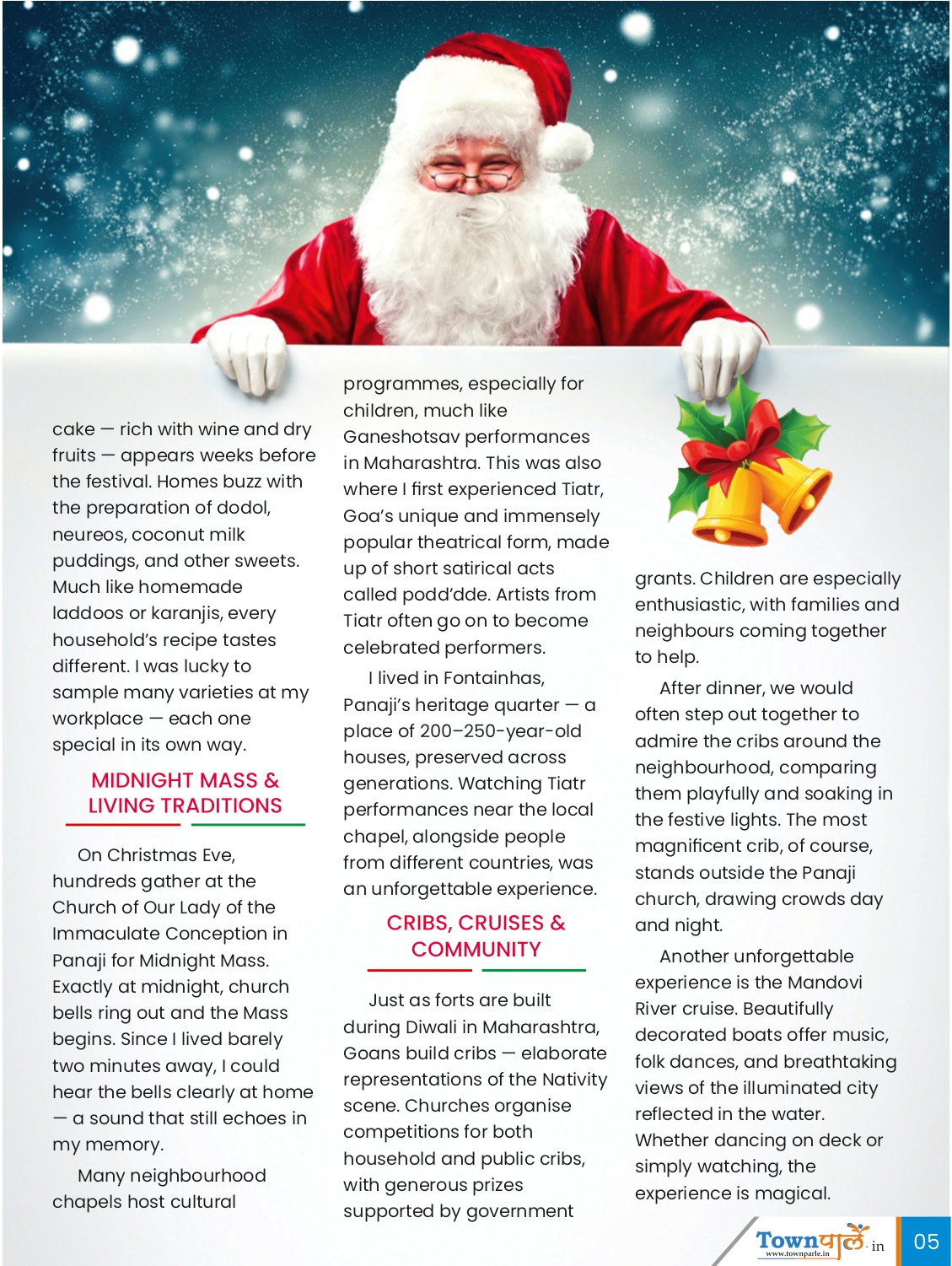
Christmas traditions like decorating trees, exchanging gifts, attending church services, carol singing, and setting up cribs are followed in Goa just as they are across the world. But Goa adds its own distinctive charm.
Markets sparkle with tinsel, huge Christmas trees are installed at public places, and traditional Goan Christmas cake — rich with wine and dry fruits — appears weeks before the festival. Homes buzz with the preparation of dodol, neureos, coconut milk puddings, and other sweets. Much like homemade laddoos or karanjis, every household’s recipe tastes different. I was lucky to sample many varieties at my workplace — each one special in its own way.
Midnight Mass & Living Traditions
On Christmas Eve, hundreds gather at the Church of Our Lady of the Immaculate Conception in Panaji for Midnight Mass. Exactly at midnight, church bells ring out and the Mass begins. Since I lived barely two minutes away, I could hear the bells clearly at home — a sound that still echoes in my memory.
Many neighbourhood chapels host cultural programmes, especially for children, much like Ganeshotsav performances in Maharashtra. This was also where I first experienced Tiatr, Goa’s unique and immensely popular theatrical form, made up of short satirical acts called podd’dde. Artists from Tiatr often go on to become celebrated performers.
I lived in Fontainhas, Panaji’s heritage quarter — a place of 200–250-year-old houses, preserved across generations. Watching Tiatr performances near the local chapel, alongside people from different countries, was an unforgettable experience.
Cribs, Cruises & Community
Just as forts are built during Diwali in Maharashtra, Goans build cribs — elaborate representations of the Nativity scene. Churches organise competitions for both household and public cribs, with generous prizes supported by government grants. Children are especially enthusiastic, with families and neighbours coming together to help.
After dinner, we would often step out together to admire the cribs around the neighbourhood, comparing them playfully and soaking in the festive lights. The most magnificent crib, of course, stands outside the Panaji church, drawing crowds day and night.
Another unforgettable experience is the Mandovi River cruise. Beautifully decorated boats offer music, folk dances, and breathtaking views of the illuminated city reflected in the water. Whether dancing on deck or simply watching, the experience is magical.
Feasts, Music & Memories
A Goan Christmas feast is unforgettable — sorpotel, roast turkey, grilled seafood, fruit cake, bebinca, dodol, neureos, perad (guava cheese), and bath made of coconut milk and semolina. These meals are enjoyed with family and friends at home, by the sea, or after church services.
Goa truly earns its title as the party capital during Christmas. From jazz and waltz to trance and electronic beats, music fills the air. While Vagator and Anjuna host rave parties, the world-famous Sunburn Festival attracts music lovers from across the globe.
Yet, locals often prefer quieter beaches, celebrating with close family and friends. Many Goans working abroad return home for Christmas, making the season even more joyous. Celebrations stretch from late November all the way into the New Year.
I still remember how my landlady encouraged me to put up a Christmas star on the balcony. The following year, I combined Christmas stars with handmade sky lanterns — a “two-in-one” idea that delighted neighbours and children alike. Those small gestures built bonds that time has not weakened.
Even today, whenever I return to India, I make it a point to spend a few days in Goa, meeting old friends. This year, the pandemic kept me away, but writing this piece stirred countless memories. Just the other day, a call came:
“Madam, we put up the star your way… we miss you while eating kuswar. When are you coming?”
As I promised a video call on Christmas Day, my eyes welled up.
Goa, like Konkan, has people with tender hearts beneath a strong exterior. Every time I see Goa from the airplane window, I feel as though the entire land is wrapped in a warm shawl of love. Perhaps that is why Christmas in Goa feels so magical — and why it keeps calling me back.
— Neela Barve
Singapore