
AI and Our Children: Are We Making Them Smarter—or Making Them Dependent?
AI can give our children answers in seconds. But are we giving them enough opportunities to find those answers themselves?
There was a time when a child came home with a difficult homework question and the first instinct was to ask a parent.Then came the encyclopaedia.Then Google.And now, there is AI.
A question that once took an evening of searching, reading, discussing and sometimes even arguing over has suddenly become a matter of typing a sentence into a box.The answer appears.Neatly written. Well structured. Often impressive.Convenient, isn’t it?
Perhaps a little too convenient. Artificial Intelligence has quietly moved into our children’s world. It can explain a difficult chapter, solve a mathematical problem, suggest ideas for a school project, write an essay, create a presentation and even help with coding.There is no denying its potential.
But somewhere between “How can AI help my child learn?” and “Let AI do it for my child”, lies a line that we may not always notice.
And perhaps that is the line parents need to think about.
The problem isn’t AI
Let us be clear.AI is not the villain.Our children are growing up in a world where artificial intelligence will be part of almost every profession. Keeping them away from it completely would be as unrealistic as asking them to ignore the internet.The real question is not whether children should use AI.
It is how they use it.
Imagine a child struggling with a mathematics problem.Earlier, the child would try.Perhaps make a mistake.Try again.Ask a friend.Ask a parent.Look through the textbook.Eventually, the answer would come.But today, one click can produce the solution.The answer is correct.The homework is complete.But what about the thinking that happened in between?That struggle may actually have been the most valuable part.Education has never been only about reaching the correct answer. It has been about learning how to reach it.
When convenience becomes dependence
The danger of AI may not be that children stop studying.It may be much more subtle.They may slowly become uncomfortable with not knowing.
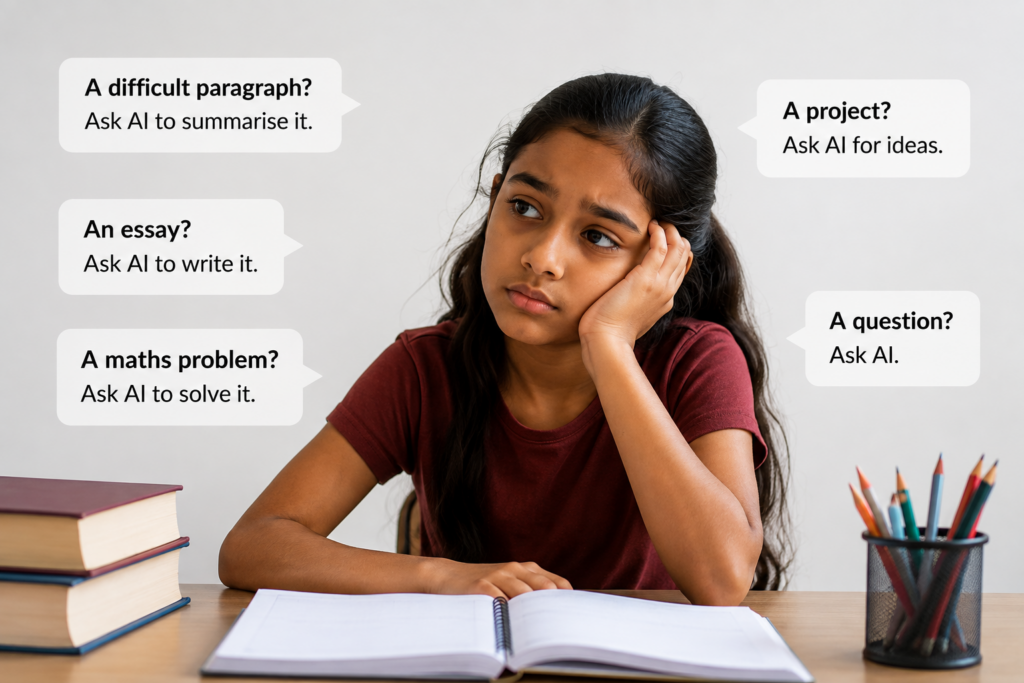
A difficult paragraph? Ask AI to summarise it.An essay? Ask AI to write it.A project? Ask AI for ideas.A maths problem? Ask AI to solve it.A question? Ask AI.And before long, the habit becomes:“Why should I think about it when something else can think about it for me?”That is where the concern begins.Because thinking is a muscle too.It needs to be exercised.Children need to experience the frustration of not knowing, the excitement of discovering something, the embarrassment of making a mistake and the satisfaction of finally figuring something out.If every difficult moment is instantly removed, are we also removing an important part of learning?
Are we becoming impatient with thinking?
We live in an age of instant gratification. Food arrives with a tap.Entertainment begins with a click.Directions appear on a screen.Answers are available almost immediately.And now, even writing can be generated in seconds.Our children have grown up with this convenience.So perhaps we shouldn’t be surprised if they begin expecting the same speed from learning.But learning doesn’t always work that way.Some things need time.A book needs to be read.A concept needs to be understood.A skill needs to be practised.An opinion needs to be formed.And sometimes, a child simply needs to sit with a difficult question for a while.
Silence, boredom and struggle are not always problems to be solved. Sometimes, they are where thinking begins.
What should parents do?
Ban AI? Probably not.Pretend it doesn’t exist?Definitely not.Instead, perhaps we need to change the conversation at home.Rather than saying,“Don’t use AI.”
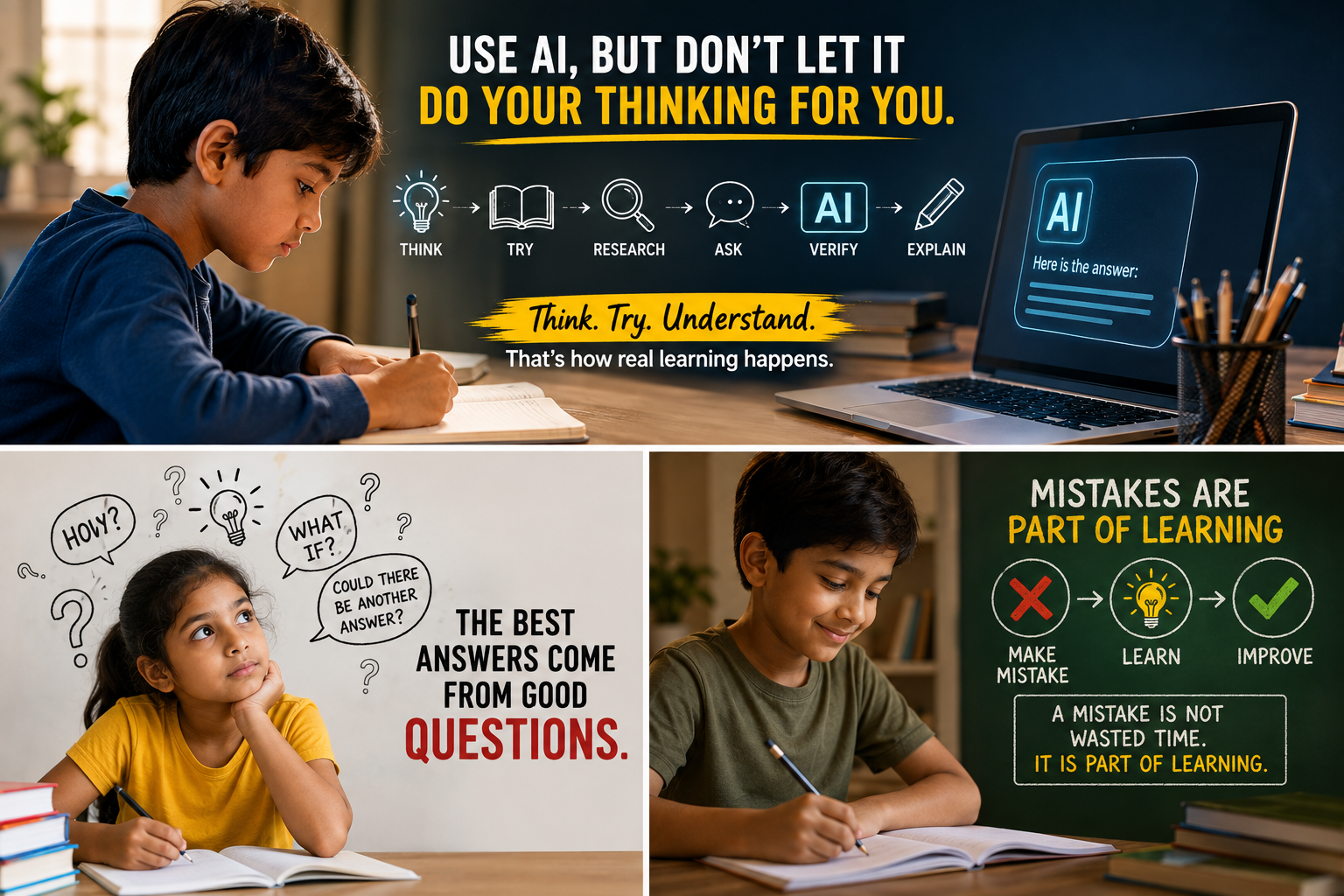
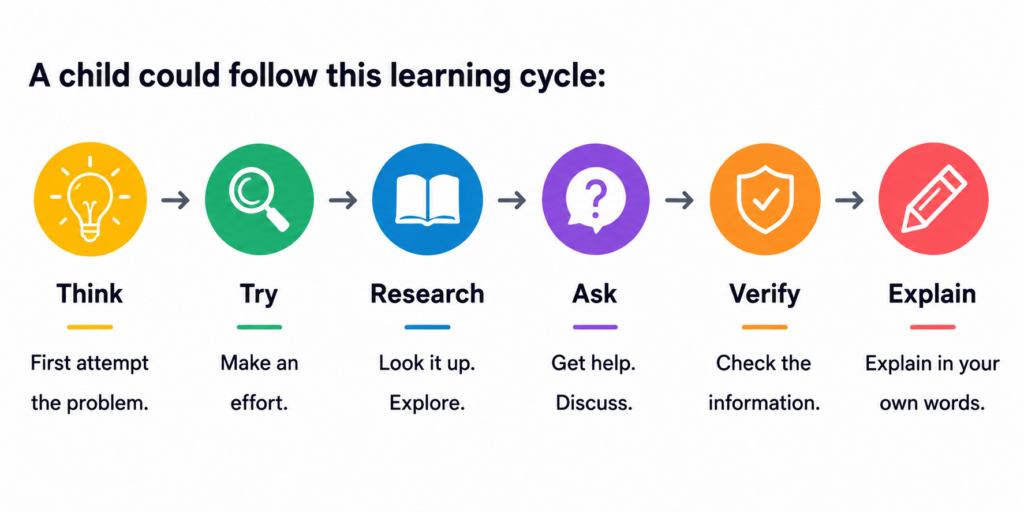
we could say, “Use AI, but don’t let it do your thinking for you.” A child could first attempt the problem. Then research it. Then use AI to understand what they missed.And finally explain the answer in their own words. Think -Try-Research-Ask-Verify-Explain.
That could become the new learning cycle.If AI gives a child an answer, perhaps the next parental question shouldn’t be, “Is your homework finished?”
It could be: “Do you understand it?”
And perhaps even more importantly:
“Do you agree with it?”
Let children make mistakes
We sometimes forget how important mistakes are.A child writes the wrong answer.The teacher corrects it.The child tries again.A science experiment doesn’t work.Try again.A story doesn’t make sense.Rewrite it.That process may look inefficient.But it is education.
If AI constantly corrects every spelling mistake, completes every sentence and provides every solution, children may never get the opportunity to discover their own errors.And discovering an error is often how we remember the correct answer.
A mistake is not wasted time. It is part of learning.
Perhaps we need to become a little more comfortable watching our children struggle.Not every struggle requires an immediate solution.
Ask them “Why?”
There is a very simple way parents can protect independent thinking.
Keep asking:
Why?
Why do you think this is correct?How did you reach that conclusion?What makes you believe it?Could there be another answer?
What does the other side say? These questions do something that no technology can do on behalf of a child.They make the child think.
And that habit will matter even more in a world overflowing with information.Because the future problem may not be finding information.
It may be knowing which information deserves to be trusted.
 The child should still be able to explain it
Here is perhaps one simple rule parents can follow.
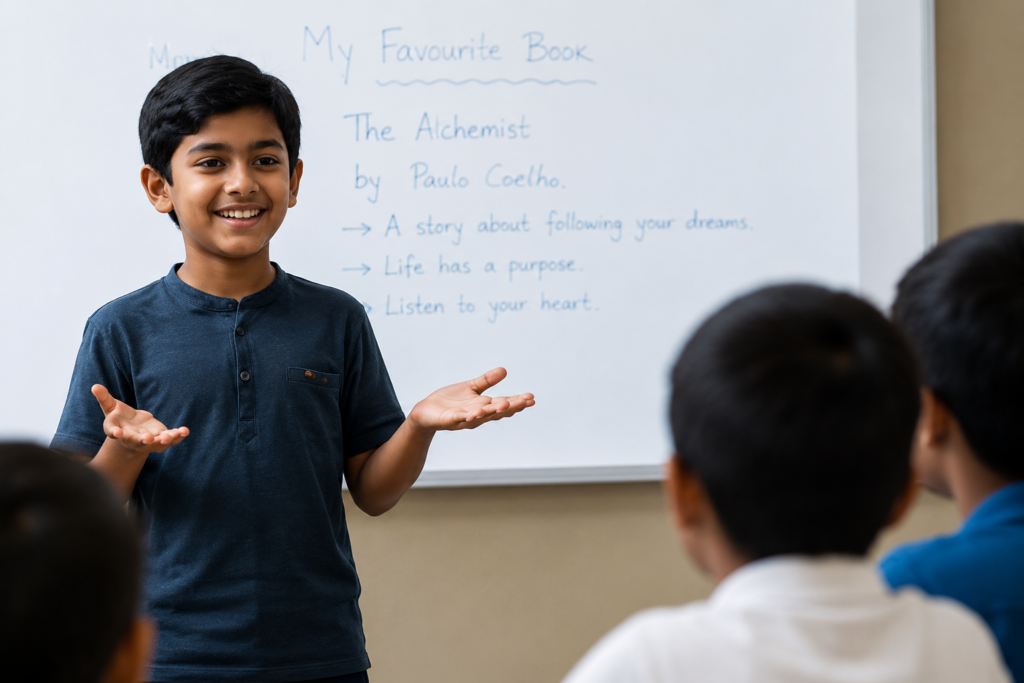
If AI helped your child write something, your child should still be able to explain it.
Without looking at the screen.
Without reading from the answer.
In their own words.
If they cannot, perhaps the assignment is complete but the learning isn’t.
This distinction will become increasingly important as AI becomes better at producing polished work.
A beautifully written essay may tell us very little about who actually did the thinking.
And that is something schools will have to grapple with too.
Schools will have to rethink learning
For years, education has often rewarded the final product.
The assignment was submitted.
The answer was marked.
The project was graded.
But in an AI-powered world, the final product may no longer tell the whole story.
Schools may increasingly need to look at the process.
Discussions.
Presentations.
Debates.
Practical projects.
Problem-solving.
Viva-style assessments.
And perhaps the simplest test of all:
“Tell me how you arrived at this answer.”
The ability to explain one’s reasoning may become more valuable than the ability to produce a flawless page.
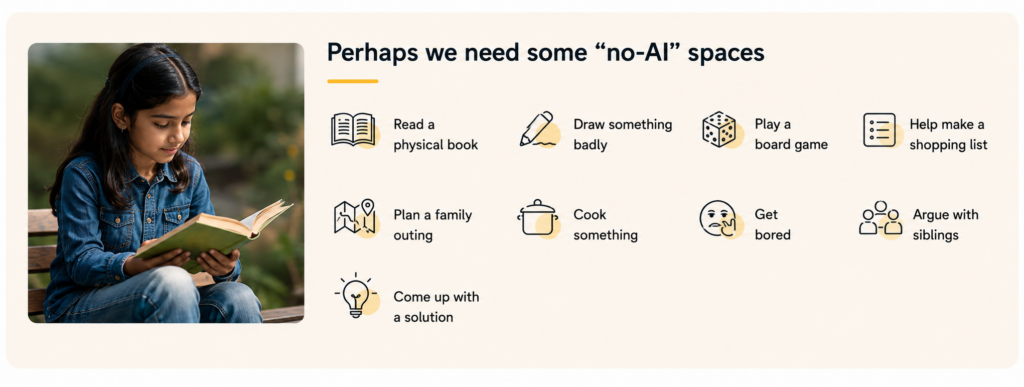
Perhaps we need some “no-AI” spaces
Not every part of childhood needs to be optimised.
Let children read a physical book.
Draw something badly.
Write a story with spelling mistakes.
Play a board game.
Plan a family outing.
Calculate how much money they need.
Help make a shopping list.
Cook something.
Get bored.
Argue with their siblings.
Come up with a solution.
These ordinary experiences quietly develop decision-making, patience, imagination and problem-solving.
Not everything needs an app.
Not every question needs an answer in five seconds.
Sometimes, the best thing we can give a child is the time to figure something out.
Teach AI literacy, not AI fear
The children of today will not live in a world without AI.
They will work alongside it.
They will use it professionally.
They may eventually depend on it for tasks we cannot even imagine today.
So fear is unlikely to be the answer.
Awareness is.
Children need to know that AI can be wrong.
It can misunderstand a question.
It can give outdated information.
It can confidently present something that isn’t true.
And just because something is written beautifully doesn’t make it correct.
Perhaps this is where AI literacy becomes as important as digital literacy.
Children need to learn not just how to ask AI questions, but how to question AI’s answers.
The smartest child may not be the one with the fastest answer
Technology will keep changing.
The tools we use today may look primitive a few years from now.
But some things will remain valuable.
Curiosity.
Judgement.
Imagination.
Empathy.
Reasoning.
The ability to listen.
The ability to disagree.
The ability to ask a better question.
And above all, the ability to think independently.
A calculator didn’t make mathematics disappear.
The internet didn’t make teachers irrelevant.
AI doesn’t have to make thinking disappear either.
But it does require us to be more conscious about what we are teaching our children.
Perhaps the goal isn’t to raise children who know how to get every answer from AI.
Perhaps the goal is to raise children who know when to use AI, when to question it, and when to put the screen away and think for themselves.
So before we ask,
“Is my child using AI?”
perhaps there is another question worth asking.
“Is my child still thinking independently?”
For the AI generation, that may be the more important question of all.
– Ruchi Adlakha