
FEBRUARY — EMOTIONS: Mastering Impulse & Mood
FEBRUARY — EMOTIONS: Mastering Impulse & Mood
A Vile Parle (East) Story — The Joshi Family (Season 2026)
Purpose Thread: Teaching daughters how emotions shape money decisions
CORE THEME
February teaches the Joshi daughters a truth most people discover the hard way:
Money decisions are emotional decisions.
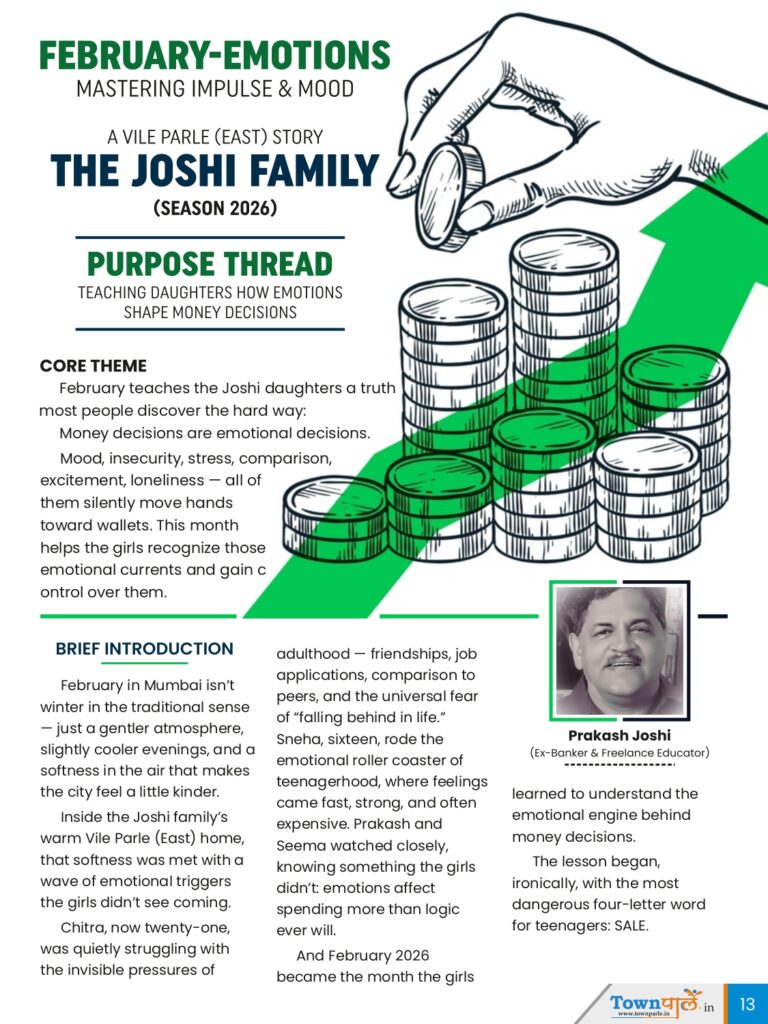
Mood, insecurity, stress, comparison, excitement, loneliness — all of them silently move hands toward wallets. This month helps the girls recognize those emotional currents and gain control over them.
BRIEF INTRODUCTION
February in Mumbai isn’t winter in the traditional sense — just a gentler atmosphere, slightly cooler evenings, and a softness in the air that makes the city feel a little kinder. Inside the Joshi family’s warm Vile Parle (East) home, that softness was met with a wave of emotional triggers the girls didn’t see coming.
Chitra, now twenty-one, was quietly struggling with the invisible pressures of adulthood — friendships, job applications, comparison to peers, and the universal fear of “falling behind in life.” Sneha, sixteen, rode the emotional roller coaster of teenagerhood, where feelings came fast, strong, and often expensive. Prakash and Seema watched closely, knowing something the girls didn’t: emotions affect spending more than logic ever will.
And February 2026 became the month the girls learned to understand the emotional engine behind money decisions.
The lesson began, ironically, with the most dangerous four-letter word for teenagers: SALE.
✨ MAIN STORY
THE MONTH EMOTIONS TRIED TO EMPTY THEIR WALLETS
On February 3rd, Chitra returned home looking unusually deflated. She dropped her bag on the sofa and sighed deeply.
“Mummy… today was awful.”
Seema, rolling dough in the kitchen, paused. “What happened?”
Chitra hesitated. “There was a massive online sale. Everyone was buying things… clothes, makeup… thousands of rupees worth. And I felt like… I HAD to buy something too.”
Sneha, who had been secretly listening from the hallway, popped her head in. “The ‘Mega Love Sale’? My entire class is obsessing over it.”
Prakash walked out from the balcony, his glasses pushed up. “So, did you buy anything?”
“No,” Chitra said softly. “But I felt left out all day.”
Sneha nodded with instant empathy. “FOMO is real. I feel it every single week.”
Seema placed the dough aside and smiled gently. “And that, girls, is exactly what we’re addressing this month.”
Sneha frowned dramatically. “We have monthly themes? Is this a Netflix family?”
Prakash chuckled. “February is about emotions and money — understanding how feelings influence our choices.”
The first lesson had begun without any lecture — just honesty.
THE EMOTIONAL SPIRAL BEGINS
- Chitra’s Comparison Trap
On February 7th, Chitra came home quieter than usual. As she scrolled through Instagram, her expression tightened. “Why does everyone look better dressed than me? Why does everyone seem richer, happier, more sorted?”
Seema sat beside her, touching her hand gently. “Beta, Instagram is not real. But the insecurity it creates is painfully real.”
Prakash added, “Comparison is the quickest way to spend money you don’t have — to impress people who aren’t even paying attention.”
Chitra whispered, “But why does it feel so urgent?”
Seema sighed. “Because emotions override logic, especially when comparison is involved.”
A MoneySmart seed quietly took root.
- Sneha’s Mood-Spending Moment
On February 10th, Sneha had a rough day at school. A misunderstanding with a friend left her hurt, confused, and frustrated — the perfect setup for emotional impulse spending. When she came home, she went straight to her room. Minutes later, Prakash received a notification: “₹790 – Dessert Jar Order Confirmed.”
He didn’t get angry. He simply called her gently.
“Sneha… did something happen today?”
That single sentence cracked her composure. “I was upset, Papa… and the dessert ad came up… and it just made me feel better for a moment.”
Prakash nodded. “That’s emotional spending. You didn’t buy dessert, beta — you bought comfort.”
Sneha wiped her eyes. “So emotions can drain money too?”
Seema joined them and said softly, “They can drain savings, peace, and decisions — faster than you think.”
Another MoneySmart seed planted.
❤️ THE FAMILY’S “EMOTION DETECTIVE” NIGHT
On February 14th, while the rest of Mumbai was busy with flowers, chocolates, and candle-lit dinners, the Joshi family sat together at their dining table with tea and chakli for something far more interesting: Emotion Detective Night.
Prakash announced, “Tonight, we figure out which emotions push us to spend.”
Sneha clapped excitedly. “This is already better than my school group projects.”
Together, they identified six classic wallet-draining emotions:
- FOMO
- Mood Fixing
- Stress Spending
- Guilt Spending
- Sale Excitement
- “I Deserve It” Syndrome
Seema said something beautifully simple:
“If you can name the emotion, you can tame the impulse.”
Sneha immediately wrote it down like a mantra.
Chitra added thoughtfully, “So instead of asking ‘What do I want to buy?’ we should ask ‘What am I feeling?’”
Prakash smiled. “Exactly. Awareness is the first step to control.”
THE FEBRUARY CHALLENGE
Seema gave the month its defining rule:
“For the rest of February, before buying anything non-essential, each of us must say aloud the emotion behind the purchase.”
Sneha gasped dramatically. “Papa too?”
Prakash burst into laughter. “Yes, beta. Even Papas have feelings.”
The challenge was officially on.
THE MOST POWERFUL MOMENT OF THE MONTH
On February 21st, Chitra approached Seema with a Kurti she had been eyeing online. “Mummy, it’s on sale. I feel like buying it.”
Seema looked at her carefully. “Which emotion wants to buy this?”
Chitra paused, took a deep breath, and whispered, “Validation. I want to feel like I’m keeping up with everyone.”
Seema hugged her tightly. “That awareness is your strength. If you can name the emotion, you choose the action. Not the emotion.”
Chitra quietly placed the Kurti aside.
That moment had nothing to do with money — it was pure maturity.
SNEHA’S VICTORY MOMENT
On February 26th, Sneha burst into the room, glowing with pride.
“Papa! I felt like buying something silly today… and I didn’t!”
Prakash smiled warmly. “Which emotion did you catch?”
She answered confidently, “Stress. And boredom. A dangerous combo.”
Seema clapped softly. “Now you understand the difference between a want… and a reaction.”
Sneha looked taller, emotionally speaking.
THE MONTH ENDS WITH A STRONGER FAMILY
On February 28th, the Joshi family gathered again in the living room. The daughters had learned more about themselves in four weeks than in many previous months.
Sneha shared,
“Controlling emotions… kind of feels like controlling money.”
Prakash nodded. “That’s one of life’s greatest truths.”
Chitra added, “Then money becomes a tool, not a trap.”
Seema smiled. “And emotional maturity becomes financial maturity.”
They were not just learning about reducing expenses. They were learning how to understand themselves.
WHAT THE DAUGHTERS LEARNED
The Emotional & Moral Layer
Integrity:
Admitting emotional spending without fear.
Self-Awareness:
Understanding the real feeling before clicking “Buy.”
Courage:
Pausing, reflecting, and making wiser choices.
Wisdom:
Realizing emotions are temporary — but money mistakes last.
Compassion:
Being gentle with themselves when emotions ran high.
Clarity:
Learning to separate “I feel like this” from “I need this.”
These emotional strengths will shape every adult decision they make.
⭐ FTWC — FROM THIS WE CONCLUDE
February teaches a life-changing truth:
To control money, you must first understand the emotions behind your choices.
FOMO whispers: “Everyone else is buying.”
Stress whispers: “You deserve comfort.”
Comparison whispers: “You’re falling behind.”
Excitement whispers: “It’s a SALE!”
But awareness whispers louder:
“Wait. Think. Feel first.”
The Joshi daughters discovered that every emotional impulse creates a financial echo — and maturity begins the moment you can say:
“I know what I’m feeling…
and I choose my action, not my emotion.”
This is the foundation of becoming truly MONEYSMART.
- Prakash Joshi