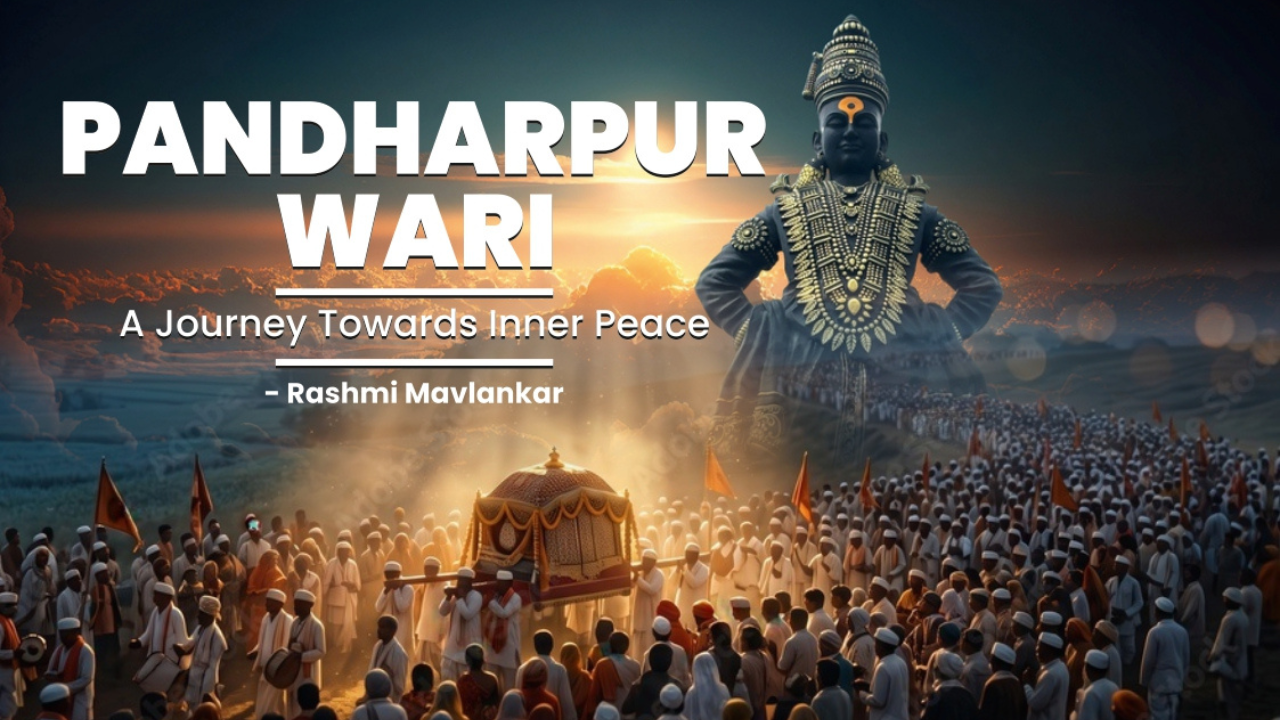
Pandharpur Wari…… A Journey Towards Inner Peace
Pandharpur Wari ….. A Journey Towards Inner Peace
By Rashmi Mavlankar
“The road to Pandharpur is not merely a path walked by the feet; it is a journey travelled by the heart.”
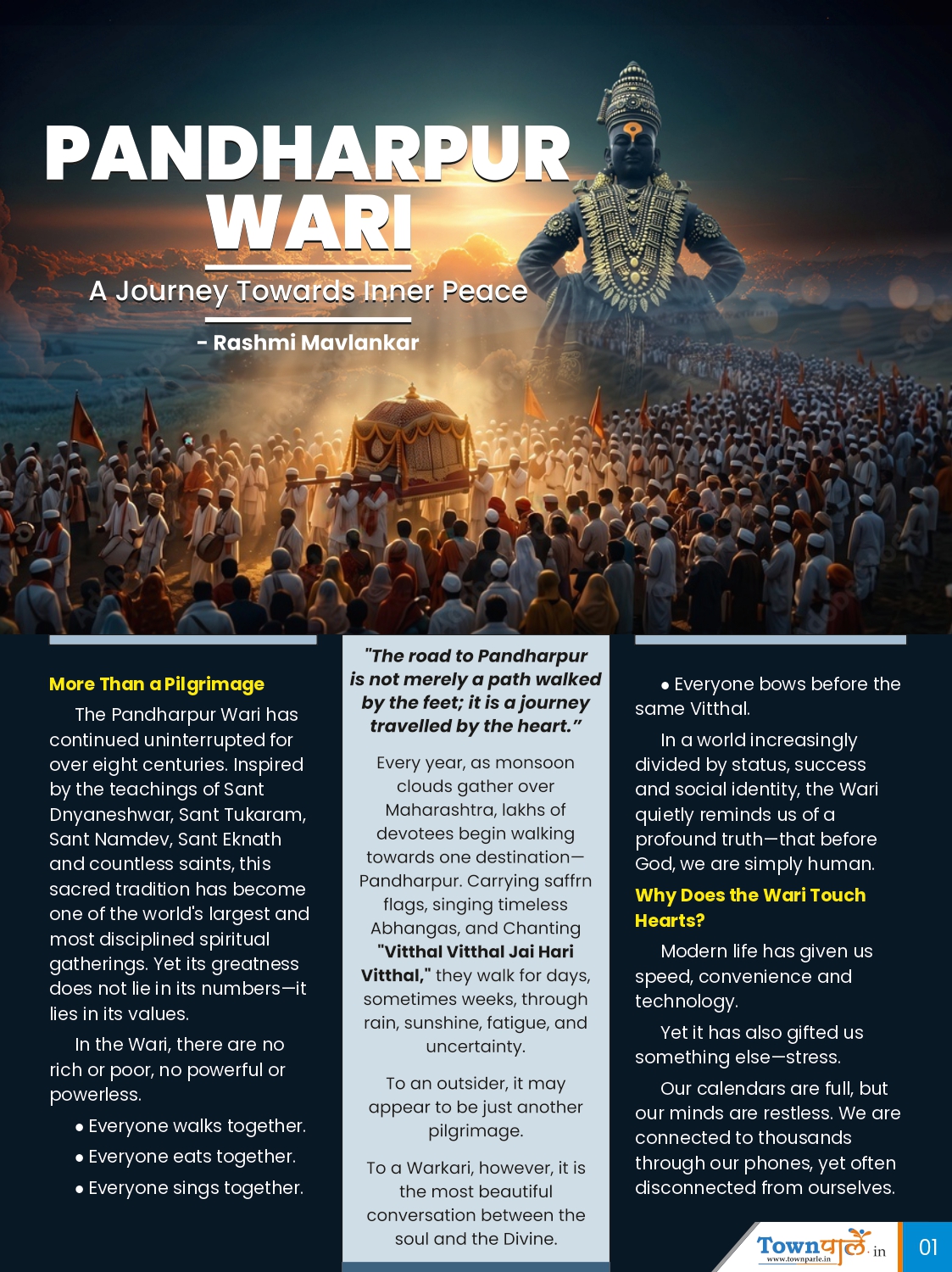
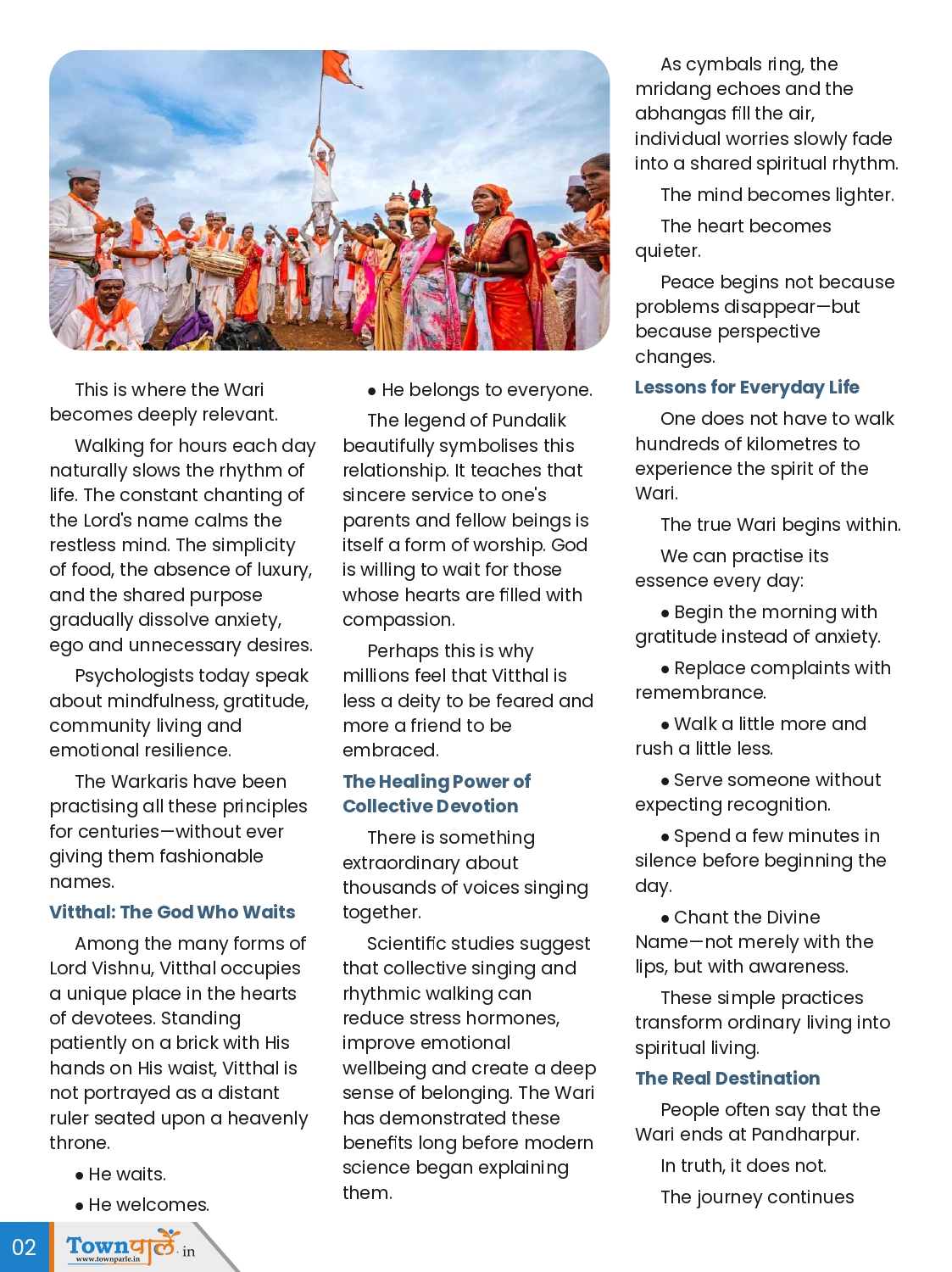
Every year, as monsoon clouds gather over Maharashtra, lakhs of devotees begin walking towards one destination—Pandharpur. Carrying saffron flags, singing timeless Abhangas, and chanting “Vitthal Vitthal Jai Hari Vitthal,” they walk for days, sometimes weeks, through rain, sunshine, fatigue, and uncertainty.
To an outsider, it may appear to be just another pilgrimage.
To a Warkari, however, it is the most beautiful conversation between the soul and the Divine.
More Than a Pilgrimage
The Pandharpur Wari has continued uninterrupted for over eight centuries. Inspired by the teachings of Sant Dnyaneshwar, Sant Tukaram, Sant Namdev, Sant Eknath and countless saints, this sacred tradition has become one of the world’s largest and most disciplined spiritual gatherings.
Yet its greatness does not lie in its numbers—it lies in its values.
In the Wari:
Everyone walks together.
Everyone eats together.
Everyone sings together.
Everyone bows before the same Vitthal.
In a world increasingly divided by status, success and social identity, the Wari quietly reminds us of a profound truth—that before God, we are simply human.
Why Does the Wari Touch Hearts?
Modern life has given us speed, convenience and technology.
Yet it has also gifted us something else—stress.
Our calendars are full, but our minds are restless. We are connected to thousands through our phones, yet often disconnected from ourselves.
This is where the Wari becomes deeply relevant.
Walking for hours each day naturally slows the rhythm of life. The constant chanting of the Lord’s name calms the restless mind. The simplicity of food, the absence of luxury, and the shared purpose gradually dissolve anxiety, ego and unnecessary desires.
Psychologists today speak about mindfulness, gratitude, community living and emotional resilience.
The Warkaris have been practising all these principles for centuries—without ever giving them fashionable names.
Vitthal: The God Who Waits
Among the many forms of Lord Vishnu, Vitthal occupies a unique place in the hearts of devotees.
Standing patiently on a brick with His hands on His waist, Vitthal is not portrayed as a distant ruler seated upon a heavenly throne.
Instead,
He waits.
He welcomes.
He belongs to everyone.
The legend of Pundalik beautifully symbolises this relationship. It teaches that sincere service to one’s parents and fellow beings is itself a form of worship. God is willing to wait for those whose hearts are filled with compassion.
Perhaps this is why millions feel that Vitthal is less a deity to be feared and more a friend to be embraced.
The Healing Power of Collective Devotion
There is something extraordinary about thousands of voices singing together.
Scientific studies suggest that collective singing and rhythmic walking can reduce stress hormones, improve emotional wellbeing and create a deep sense of belonging. The Wari has demonstrated these benefits long before modern science began explaining them.
As cymbals ring, the mridang echoes and the abhangas fill the air, individual worries slowly fade into a shared spiritual rhythm.
The mind becomes lighter.
The heart becomes quieter.
Peace begins not because problems disappear—but because perspective changes.
Lessons for Everyday Life
One does not have to walk hundreds of kilometres to experience the spirit of the Wari.
The true Wari begins within.
We can practise its essence every day:
- Begin the morning with gratitude instead of anxiety.
- Replace complaints with remembrance.
- Walk a little more and rush a little less.
- Serve someone without expecting recognition.
- Spend a few minutes in silence before beginning the day.
- Chant the Divine Name—not merely with the lips, but with awareness.
These simple practices transform ordinary living into spiritual living.
The Real Destination
People often say that the Wari ends at Pandharpur.
In truth, it does not.
The journey continues every time a person chooses kindness over anger, humility over ego, faith over fear, and contentment over endless desire.
Ashadhi Ekadashi is therefore not only a festival.
It is:
- An invitation.
- An invitation to pause.
- To simplify.
- To reconnect with ourselves.
- To remember that the greatest pilgrimage is not measured in kilometres but in the distance travelled from the restless mind to the peaceful heart.
Perhaps that is why generations continue to walk towards Pandharpur.
Not because Vitthal lives only there.
But because somewhere along that sacred road, they rediscover the Vitthal who has always lived within.