

The Family Doctor: An Old Bond in a New Age of Healthcare
There was a time when a fever, a persistent cough, a child’s stomach ache or an elderly parent feeling unwell meant reaching for the phone and calling one familiar person—the family doctor.
You did not need to explain everything. The doctor already knew the family: who had diabetes, who suffered from allergies, which child was prone to infections, and whose blood pressure needed watching. The relationship went far beyond a consultation. The family doctor was often someone the entire family *knew, trusted and relied upon.
For many families in Mumbai, including those in Vile Parle, the neighbourhood doctor was once an integral part of everyday life. A modest clinic, a few chairs in the waiting room, a stethoscope and a familiar voice were often enough to create a sense of reassurance. Sometimes, a quick phone call was all it took to decide whether a visit was necessary.
Today, healthcare looks very different.
We have specialists for almost every medical condition, advanced diagnostic centres, online consultations, health apps and easy access to medical information. If we have a particular problem, finding a specialist is easier than ever.
Yet, interestingly, the role of the family doctor has not disappeared. It has evolved.
A modern family doctor is not expected to treat every condition personally. Instead, they can become the first point of contact for the family—understanding the overall health history, identifying warning signs, recommending preventive tests and, when necessary, directing the patient to the right specialist.
This becomes particularly valuable when a person is seeing multiple doctors. A cardiologist may be treating one issue, an orthopaedic specialist another, while a gynaecologist or endocrinologist may be involved in a different aspect of health. Having one doctor who understands the larger picture can help bring some continuity to this otherwise fragmented healthcare journey.
The importance of a family doctor is perhaps even greater today because many health problems are closely connected to our lifestyles. Diabetes, hypertension, obesity, stress, sleep problems and cardiovascular risks often develop gradually. Regular interaction with a trusted doctor can encourage preventive care rather than waiting until a health problem becomes serious.
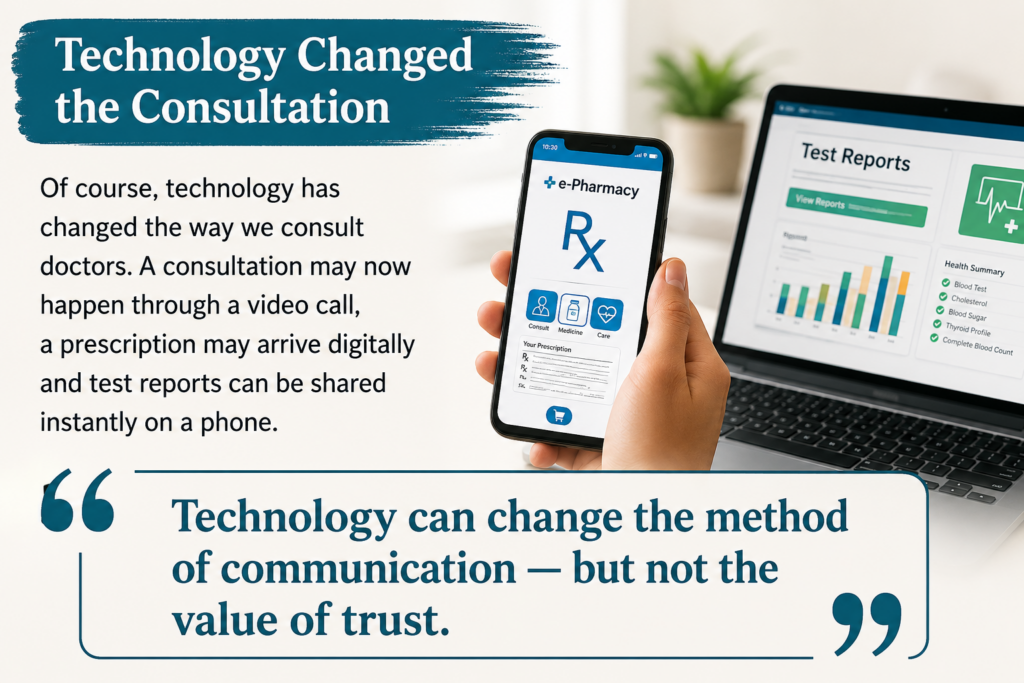
Of course, technology has changed the way we consult doctors. A consultation may now happen through a video call, a prescription may arrive digitally and test reports can be shared instantly on a phone. But technology can only change the method of communication—not the value of trust.
Perhaps that is why the idea of a family doctor continues to evoke such warmth and nostalgia.
The old neighbourhood doctor may have been replaced by a modern clinic, a digital appointment or a multidisciplinary healthcare centre. But the underlying relationship remains the same: a doctor who knows the person behind the patient.
In an age of super-specialists and sophisticated medical technology, the family doctor can still be the thread that connects it all—a trusted healthcare companion who knows where the medical journey begins, understands the family’s history and knows when it is time to take the next step.
Healthcare may have moved from the old clinic to the digital age. But the need for trust has remained timeless