URBAN WASTE MANAGEMENT……..
With the ever growing urban waste, especially in cities, it has become a matter of challenge for authorities firstly for its correct disposal without supplementing much on the already taxed environment and secondly how supremely we can biodegrade it within the same premises.
The most recognizable and constructive way to manage waste is by way of segregation of dry waste and wet waste. As we all know this is made mandatory by the municipal authorities. All dry waste is to be separated in each home and it is to be collected separately and recycled. This is easily bought by our scrap dealer located at corners of our neighborhood. Similarly all wet or organic waste can be composted to form nutrient rich fertilizer within our premises that can be mixed back to our mother earth.
It is the most effortless way to give the natural ingredients back to the soil and enrich it. Advantage of this is that every society who effectively segregates and composts can avail appreciating certification from municipal authorities and future consideration for rebate in the property tax assessment. This is a reward for making segregation job easy and labor free.
One such example of society which has availed such subsidy is our Datta Niwas Co-op. Hsg. Society Ltd. on Ajmal Road, in Vile Parle east. Here we are following a routine for past 8 years, to convert the collected wet waste effectively into a rich natural fertilizer.
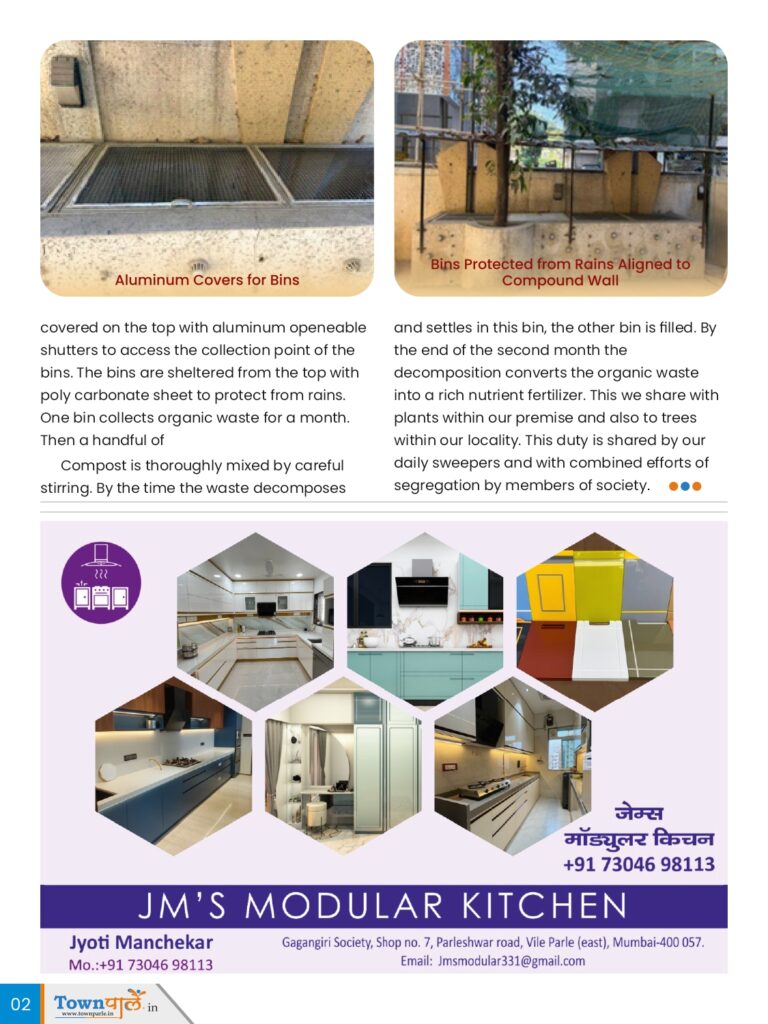
The requirements for this are manageable. Two concrete bins of 3ft high, 2ft wide and 1.5ft depth are built in one corner aligning to the compound wall. These bins have perforations about 1 inch dia at intervals to allow moisture to escape. Bins are covered on the top with aluminum openeable shutters to access the collection point of the bins. The bins are sheltered from the top with poly carbonate sheet to protect from rains. One bin collects organic waste for a month. Then a handful of Compost is thoroughly mixed by careful stirring. By the time the waste decomposes and settles in this bin, the other bin is filled. By the end of the second month the decomposition converts the organic waste into a rich nutrient fertilizer. This we share with plants within our premise and also to trees within our locality. This duty is shared by our daily sweepers and with combined efforts of segregation by members of society.
Care must only be taken to keep the walls of the bins perforated with only 1 inch diameter holes on sides and aluminum openable shutters on top to allow mixing of compost and removal of the fertilizer at a cycle of 45-60 days otherwise this an odor free process. A thin polycarbonate sheet can be covered as a roof on top to disallow water from entering. This may hamper the fertilizing process and may result in damp stench. Our society through this has achieved a certificate and a subsidy rebate of 5% in the assessment taxes. A practical demonstration and guidance about vermicomposting in your home will be instrumental in achieving disposal and composting program.
With climate change and environmental issues cascading every day, this is the least we could do to contribute towards being a more responsible human being, without taxing much on our commodities. A primary step in accomplishing a better habitat.
Ar. Rashmi Phulkar (Practicing Architect, Vile Parle EAST)