VIRTUAL REALITY of THE BUILDING INDUSTRY
An Architect shapes the environment while fulfilling human needs and his structures stand a test of time. His ideas, ideologies and art work are such that they have to be conveyed to a common person as well as a technical one. To showcase his designing skills he has to present the visuals generally as a three dimension sketch on paper, or in the form of a model or at times on unfurnished walls which form a canvas to
explain minute details.
Where the Architect presents his designs to the clients or developers, the developer and the builder too wants to proffer their ventures to their clients in the same significant way. With the advancement of computer technology in every sector of industry,
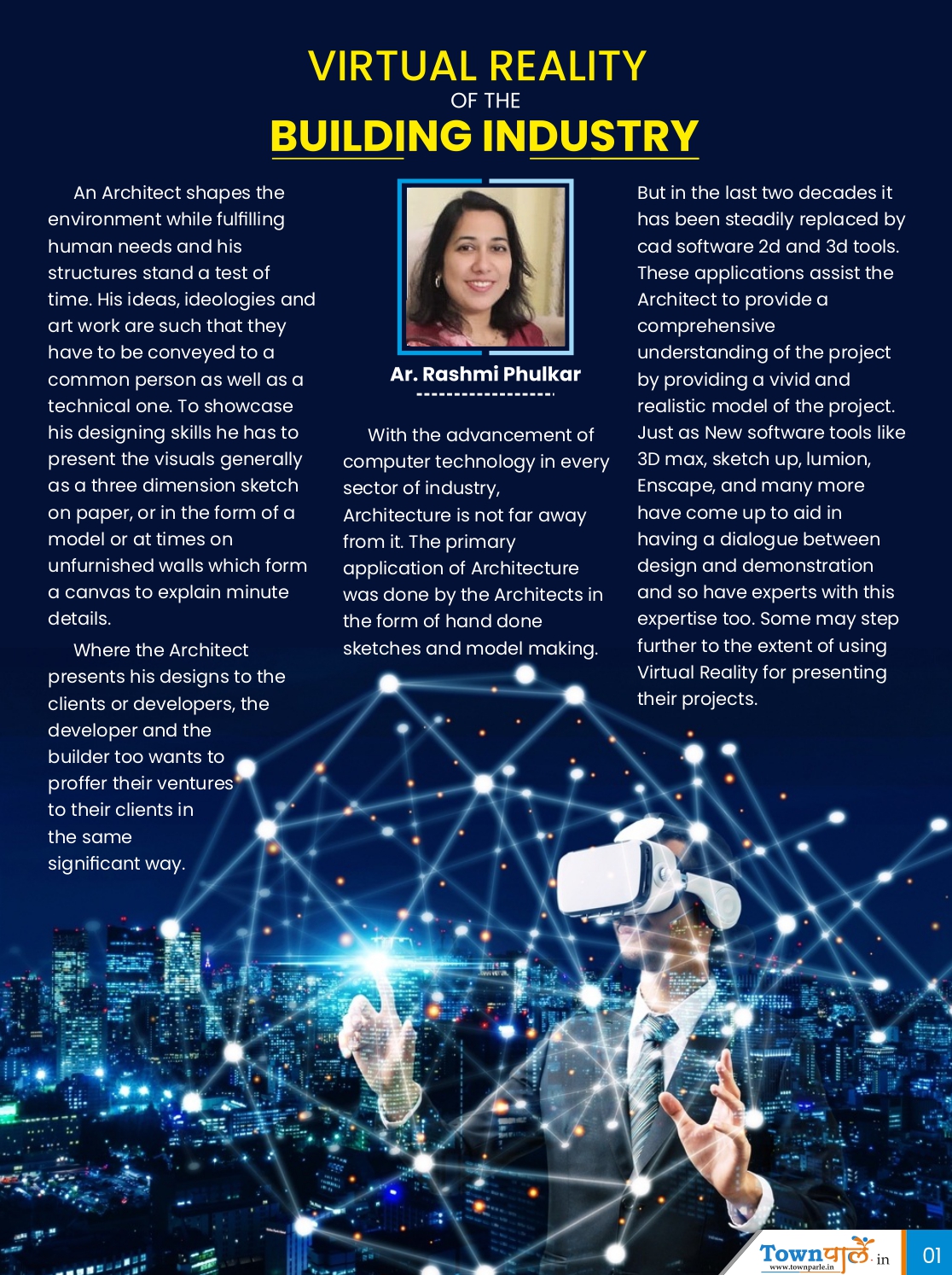
Architecture is not far away from it. The primary application of Architecture was done by the Architects in the form of hand done sketches and model making. But in the last two decades it has been steadily replaced by cad software 2d and 3d tools. These applications assist the Architect to provide a comprehensive understanding of the project by providing a vivid and realistic model of the project. Just as New software tools like 3D max, sketch up, lumion, Enscape, and many more have come up to aid in having a dialogue between design and demonstration and so have experts with this expertise too. Some may step further to the extent of using Virtual Reality for presenting
their projects.
Here software technology clearly supersedes the design parameters and the Architect has to keep upgrading his presentation skills in order to contribute to his vision. If not then a strategic partner is integrated along who has such expertise to deliver a real life experience to navigate through their schemes.
Imagine a person gets a walkthrough of his own house before it has been constructed. He can feel his space in real time, where he would be living after a couple of years. Experts are hired who will aid in offering an immersive and interactive exercise to woo its customers. It does give a larger than life impression and may create a rosy picture to please the prospective buyers but can be gullible at times. It can be a total
depiction of design given by the graphic artist who may not know the relevance of technical details while presenting a glossy impression. These gaps in virtual dynamics may be misleading. The reality of virtuality is that much freedom is given to creativity here, but details may be lost in transition.
It is a simple advice to the buyers to not fall prey to such fancy gimmicks but to be seeing through a more informed model. Rather than assessing a virtual impression, the purchaser should scrutinize aspects like reputation of the developer, carpet area of the property to be purchased, quality of materials and accessories used, the amenities mentioned in the scheme. Any associated costs should be verified beforehand to avoid future issues. People should not sway to powerful tools of conceptions, as new ideas are generated only and only through brain and presented only through such applications.
A powerful invention tool only enhances experiences through its ethical complexities but ultimately it is the authentic human experience choice which will always remain irreplaceable.
Ar. Rashmi Phulkar (Practicing Architect, Vile Parle EAST)